What it's about
Finally a breakthrough!!!!
since autumn 2015, two laboratories have offered a genetic test that checks the genetic predisposition for resistance to developing FIP.
If, as a breeder, you follow the legal regulations and replace a kitten that died of FIP, then the cost of testing your whole cattery is already covered by just one kitten that did NOT die :)
Time will tell whether this test can help contain this terrible disease.
What is written here is my opinion, my work and my results in FIP resistance work; it makes no claim to be complete.
My thoughts on this FIP-R gene test and foreword
It is my way of doing something for the health of my little Birmans.
I am making it public because I think some breeders may benefit from it. I don't want to convert any breeder, I earn nothing from it, and I have no sponsors or anything similar. I don't claim it is the ONLY way. I don't claim that anyone who tests will never have FIP problems again. It is a long road to success.
For me, it is first and foremost genetics-based work for breeders. To everyone who thinks this test and my work are pointless:
PROVE ME WRONG!
I can document my successes :) :) :)
I am happy to give information to anyone who is interested
What is written here is my opinion, my work and my results in FIP resistance work; it makes no claim to be complete or exclusive. Please note that I am not a vet and have worked all of this out myself, so mistakes may occur.
My breeding programme
Because I think it is important to do something about FIP prevention, I started a breeding programme. Since the end of 2015, the Animalab laboratory in Zagreb has offered a genetic test for FIP resistance.
Since 2021 I have been testing in France with Genimal, as the laboratory in Croatia works too slowly.
My pairings are chosen based on the results of the FIPR test. I can also count on the cooperation of some breeder friends :)
for me as a breeder, this means:
with targeted pairings, it is possible to breed healthy, genetically FIP-resistant cats within 3 generations!
Beautiful cats that don't have "good values" don't have to be removed from breeding straight away; a well-considered pairing improves the results in their offspring.
Edit August 2024: After years of consistent testing and pairing, I now have my first breeding cats that are homozygous FIP-resistant. :)))))
My Zansa
and also Cassipopeia and Cleopatra
What does homozygous and heterozygous mean?
If both alleles of an individual are the same for a particular trait, the genetic makeup for that trait is pure-bred or homozygous. If there are two different alleles, this is called mixed inheritance or heterozygosity.
My results
In 2024
all my breeding cats are heterozygous (one allele FIP-resistant, one allele not resistant). Three cats are homozygous (on both alleles) FIP-resistant
I am incredibly proud and very happy about this. The pairings of 2024 will show how much further I can improve my cats' values and how meaningful the test is.
In 2024
Since December 2015, I have had all my cats tested for their FIP resistance
and have chosen my pairings accordingly.
This has allowed me to improve my values significantly :)
anything in between is possible .... in my experience, it is important to me that the breeding cats at the top have a yellow or green dot (the laboratory in France only tests the first gene anyway: fIFNG 428)
If you have any questions, I will be very happy to answer them.
Outlook 2022
An international Facebook group of breeders and vets of all breeds has been formed
Gêne T Résistantcats
currently 531 members
An initiative of this group got the French LOOF involved. LOOF reviewed the request and wants to push for a study at the University of Lyon on our topic. We are very proud and excited :)
there is also a small Facebook group in Germany, mainly with Birman breeders
FIP-R gene test
The purpose of these groups is to share experiences and to exchange FIP-R youngsters with each other. That way the road to healthy cats is faster :)
Outlook 2023
*I am very proud that I now have 3 females that are FIP-R/FIP-R :)
meaning resistant on both alleles of this gene
*All other breeding cats are FIPR/N
meaning resistant on one allele of this gene
The FIP-R gene can prevent a cat from developing FIP even though the coronavirus is present
Inheritance chart for my future litters
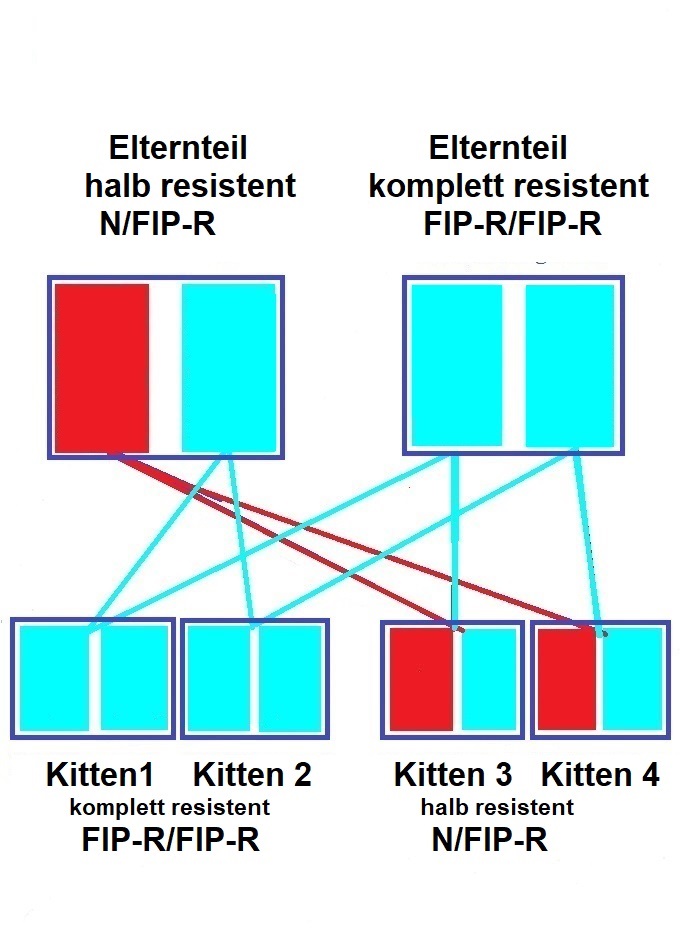
Female FIP-R/FIP-R 😊 (Zanza, Cassipopeia, Cleopatra): kittens FIP-R/FIP-R 50 % each 😊, FIP-R/N 50 % each 😐
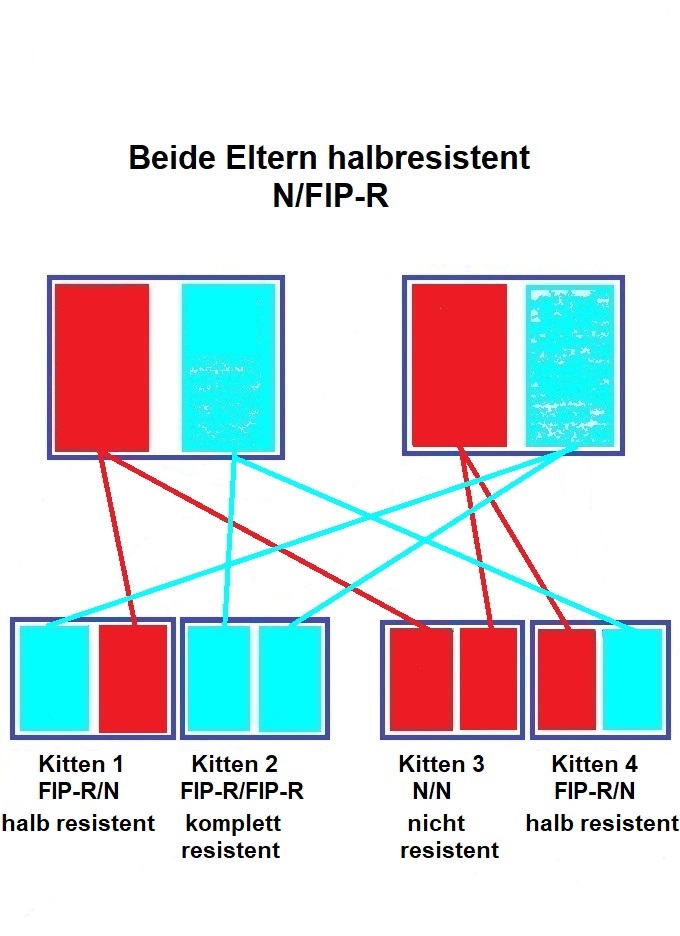
Female FIP-R/N 😐 (Milla): kittens FIPR/FIPR 25 % each 😊, FIPR/N 50 % each 😐, N/N 25 % each ☹
Outlook 2024
For the first time I can pair cats that
good values x very good values
have
The goal is to only have breeding cats with very good (homozygous) FIP-R values
the future will show whether my path is the right one.
Inheritance chart and breeding recommendation
Here is the new inheritance chart
for the first FIP-R gene ( fIFNG c 428>C ) tested at Genimal.
Every gene has two alleles, one from the mother and one from the father
N/N
N/FIP-R or FIP-R/N
FIP-R/FIP-R
Half resistant means the cat is protected from developing FIP, because the good gene is dominant over the bad gene
below is a chart showing how the individual alleles can be distributed
Female FIPR/FIPR 😊: kittens FIPR/N 😐
Female FIPR/N or N/FIPR 😐: kittens FIPR/N or N/FIPR or N/N 😐😐☹
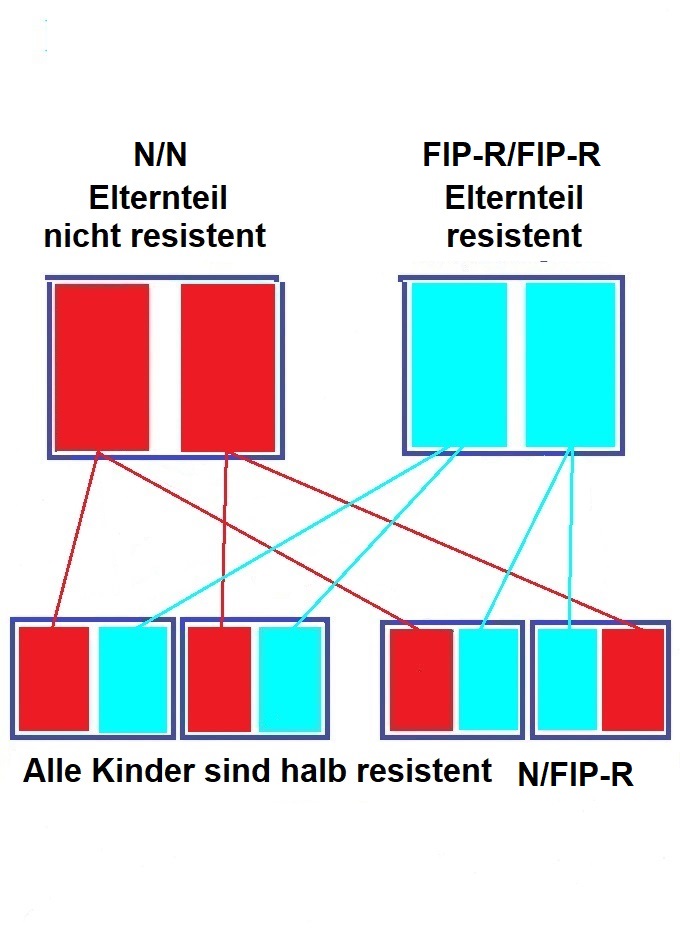
Female N/N ☹: all kittens N/N ☹
Female FIPR/FIPR 😊: kittens FIPR/N or N/FIPR or FIPR/FIPR 😐😐😊
Female FIPR/N or N/FIPR 😐: kittens FIPR/FIPR or FIPR/N or N/FIPR or N/N 😊😐☹
Female N/N ☹: kittens FIPR/N or N/FIPR or N/N 😐☹
Female FIPR/FIPR 😊: all kittens FIPR/FIPR 😊
Female FIPR/N or N/FIPR 😐: kittens FIPR/FIPR or FIPR/N or N/FIPR 😊😐😐
Female N/N ☹: FIPR/N or N/FIPR 😐😐
These inheritance combinations can also be applied to the remaining 5 genes tested at Animalabs. So it is far from as simple as it first seemed.
The inheritance chart is based on my own findings!
There are certainly other factors that can trigger FIP as well.
My work is one pillar in the fight against FIP, but a very important one to me!!!
The 3 pillars of prevention
1. Genetics:
As already described here under the overall topic of FIP gene testing, every breeder should aim to breed cats that are resistant to developing FIP on one or two alleles.
Since many breeders across Europe now take part in this program, it should no longer be a problem to buy resistant breeding cats, or to select the resistant cats by means of gene tests.
2. A healthy gut
In the section on corona & co, I already explained that a healthy gut, and with it a good immune system, can eliminate the coronavirus in the cat. Of course, this includes a good, balanced diet.
3. The psychological component
Stress makes you sick!!!! That's not only true for us humans, but also for our sensitive little Birmans. So the rule is: avoid stress! I once had a male who kept pulling out the hair on his tail. The animal communicator told us he was unhappy (he was a former breeding male and now lived with us as a neuter). Then at the age of 9 he developed FIP :( and died :(
Corona & Co
or how contagious are coronaviruses and other intestinal parasites
well, I'm not a meticulous cleaner,
- I use Ultraklump cat litter
- several cats share one litter box
- the litter box is cleared of feces and clumps 2 x a day
- about every 2 to 3 weeks the litter is changed completely and the box is cleaned thoroughly
In 2017 we took part in a coronavirus study by LMU München
feces samples were taken from 10 cats once a week over a period of 4 weeks, so 4 samples per cat, followed by a blood test for coronavirus antibodies
the result amazed me, see also further below
- of 10 cats, only one cat currently had coronaviruses
- during the test period we had one FIP death; this cat lived TOGETHER with the other cats but was not part of the test program
- 9 cats had an antibody titer for coronaviruses
- in 9 out of 10 cats no coronaviruses were found in the feces
- of 10 cats, two cats had giardia
- All cats shared the litter boxes
My conclusion from this story:
With good intestinal bacteria, cats are better able to eliminate coronaviruses......all cats had an antibody titer, so all cats had gone through a coronavirus infection
The be-all and end-all is a healthy gut
- From the 3rd week of life, our cats receive good intestinal bacteria with their food every day, the adult cats too
- I believe a healthy gut = a healthy organism/body
- a healthy gut also copes better with intestinal parasites
For breeders: the path to success
The not-so-easy road to success:
If you decide to start a breeding program for genetic resistance to FIP in your cattery.
It won't be easy:
Test all your breeding cats, and also the studs you use for outside matings, then test all young cats you want to keep for breeding.
At first it's not a problem if you have cats with poor values.
but
One of the mating partners should have good values.
once the litter has arrived, all kittens should be tested; the show quality of the kittens should take a back seat for now.
Here is an example:
Here a female, Poppi the cosy One (poor values) x male, Blue Team Guerlain (better values, the first gene yellow) was mated, and the kitten with the best values was kept as a breeding female, Tilda the cosy One.
The kittens with poor values are sold as usual.
Following on, Tilda's daughter, Zanza the cosy One, is FIPR/FIPR
so you can achieve a great deal in 3 generations :)
Let's talk about money:
The test in France at Genimal/France costs between 55 - 60 euros
I don't accept the argument that the tests are too expensive. As a decent breeder, you provide a replacement if a kitten has died of FIP. Anyone can do the maths: if you lose 2 kittens a year, you can easily pay for the cattery's annual tests.
Another argument is the very expensive treatment with GS once the disease has broken out and has to be treated.
Not to be underestimated: the emotional strain on the breeder
Let's not kid ourselves, it takes a lot of courage to bring yourself to do the tests.
With my first tests, I was "sick" from the day the samples/swabs were taken until I received the results. Sleepless nights and a queasy stomach were part of everyday life.
When the result comes, so does the shock that your beautiful, beloved, successful champion has poor values, and then it's important:
----don't panic---
I know, that's a lot to cope with :(
A bad result does not mean that your kitty is going to die of FIP right away.
So please stay calm.
A bad result means that the cat may die of FIP at some point during its life; that could be at one year old, at 15 years old, or never at all.
What matters is choosing the right mating partner; that way you can breed the bad values out.
How do I get cats with good values
After many years of breeding, I know how hard it was to get beautiful breeding cats. Getting beautiful cats that also had good values was almost impossible.
Now that there is the fb group Gene T Resistantcats
and the fb group FIP R Gentest
it is much easier: the members of these groups can buy and sell tested kittens among each other :)
You should also base your purchase decision on the test result.
Perseverance is EVERYTHING
Once you start as a breeder, you have to keep going, otherwise all the work, the money, the worries and the breeding selection will have been for nothing.
It is a hard road, but within 3-5 years you should get to the point where you have cats with good values.
FIP mortality goes down (that was the case for me). I was able to breed it out of my lines.
Here is the pawpeds link to this line. The kittens from the V litter, from R-Wurf and from the 0 litter are all healthy
https://pawpeds.com/db/?a=p&id=1505612&g=4&p=sbi&o=elastic
The psychological pressure on the breeder eases.
The first successes become noticeable.
Personally, I can say I feel good; the feeling of being able to do something is wonderful.
The constant fear of a phone call goes away, and knowing you are on the right path is wonderful.
The road from "bad to good" in 3-4 years :)
Kami x Quintin = P litter 17.07.2017
bad x bad = bad :(
Poppi was kept for further breeding
Poppi x Guerlain = T-Wurf 02.04.2019
bad x good
Tilda was kept for further breeding
The mating of Tilda and Roddy = Z-Wurf
from this I got my first homozygous FIP-resistant cat
So you can see how, with a little breeding work, you can get cats with good FIP-R values from cats with bad FIP-R values.
Laboratories
http://www.genimal.com/test_ADN_chat.html
Here the test costs 60 euros per cat
I recommend the laboratory in France,
- the processing time for the test is much shorter
- the costs are lower
- only the first gene is tested, but in my opinion that is the most important/decisive gene for resistance
Animalabs/Kroatien
here the test costs 79,90 euros per cat
Breeders who want to have several animals tested can ask for a discount;
every year around Christmas there is a special offer: pay for 2 tests, get 3 tests
I would recommend the laboratory in France, as there are very long waiting times in Croatia
Edit August 2020: After 5 years of testing, I have to say that the first gene (in France only the first gene is tested) should be yellow or green.
A responsible breeder should include cats in their breeding programme whose first gene is yellow or green.
Sources
Here are some links to the research papers:
- Genetic susceptibility to feline infectious peritonitis in Birman cats. Golovko L, Lyons LA, Liu H, Sørensen A, Wehnert S, Pedersen NC Virus Res. 2013 Ju
- The influence of age and genetics on natural resistance to experimentally induced feline infectious peritonitis. Pedersen NC, Liu H, Gandolfi B, Lyons LA. Vet Immunol Immunopathol. 2014 Nov 15;
- Polymorphisms in the feline TNFA and CD209 genes are associated with the outcome of feline coronavirus infection. Wang YT, Hsieh LE, Dai YR, Chueh LL. Vet Res. 2014 Dec
- Identification and genotyping of feline infectious peritonitis-associated single nucleotide polymorphisms in the feline interferon-γ gene. Hsieh LE, Chueh LL. Vet Res. 2014 May
the Winn Feline Foundation also points to the genetic test
Outlook 2025
I am very proud that I now have females that are FIP-R/FIP-R :) meaning resistant on both alleles of this gene.
All our other breeding cats are FIPR/N, which means they are resistant on one allele of this gene.
The FIP-R gene can prevent a cat from developing FIP even though the coronavirus is present.
Inheritance chart for my future litters
Female FIP-R/FIP-R (Zanza) × male FIP-R/N (ZEZ): kittens FIP-R/FIP-R 50 % each, FIP-R/N 50 % each
Female FIP-R/N × male FIP-R/N (ZEZ): kittens FIPR/FIPR 25 % each, FIPR/N 50 % each, N/N 25 % each
Through the publication of my work and with the support of my vet Dr. Ines Schmid and of Dr. Kikovic, a vet and cat breeder, others who are interested have taken notice too.
An international Facebook group of breeders and vets of all breeds has formed (currently 568 members): https://www.facebook.com/groups/699263627387473
An initiative of this group has brought in the French LOOF. LOOF has reviewed the request and wants to push forward a study on our topic at the University of Lyon. We are very proud and excited :)
There is also a small Facebook group in Germany, mainly with Birman breeders: https://www.facebook.com/groups/178895999119147
The purpose of these groups is to share knowledge and to exchange FIP-R young cats with one another. That way the road to healthy cats is shorter :)
A little genetics
Here is a little more genetics to help you understand :)
When cats are mated, each parent contributes one allele (a trait, e.g. healthy/ill, red/mint-coloured) to the genetic cocktail. The mix is random.
Every gene in a cat is made up of two alleles: one allele from the mother, one allele from the father.
A gene is the section of DNA that acts as the localised carrier of a hereditary trait.
Recessive inheritance: in a genetic disease with recessive inheritance, both parents carry a defective gene but are healthy, because the second, normal gene is dominant.
If the expression of a trait requires only one copy of a gene (one allele), the trait is dominant. If it requires 2 copies (2 alleles), it is recessive.
Through mutation, a gene has now formed that shows resistance to the development of FIP. This gene has been testable since 2015.
If a cat is N/N, it is not resistant to the development of FIP.
If the cat is N/FIPR, it has one allele that is resistant and one allele that is not. The cat is nevertheless protected, because the resistance allele is dominant.
If the cat is FIP-R/FIP-R, it has inherited the „good gene" from both mother and father and is homozygously resistant to developing FIP.