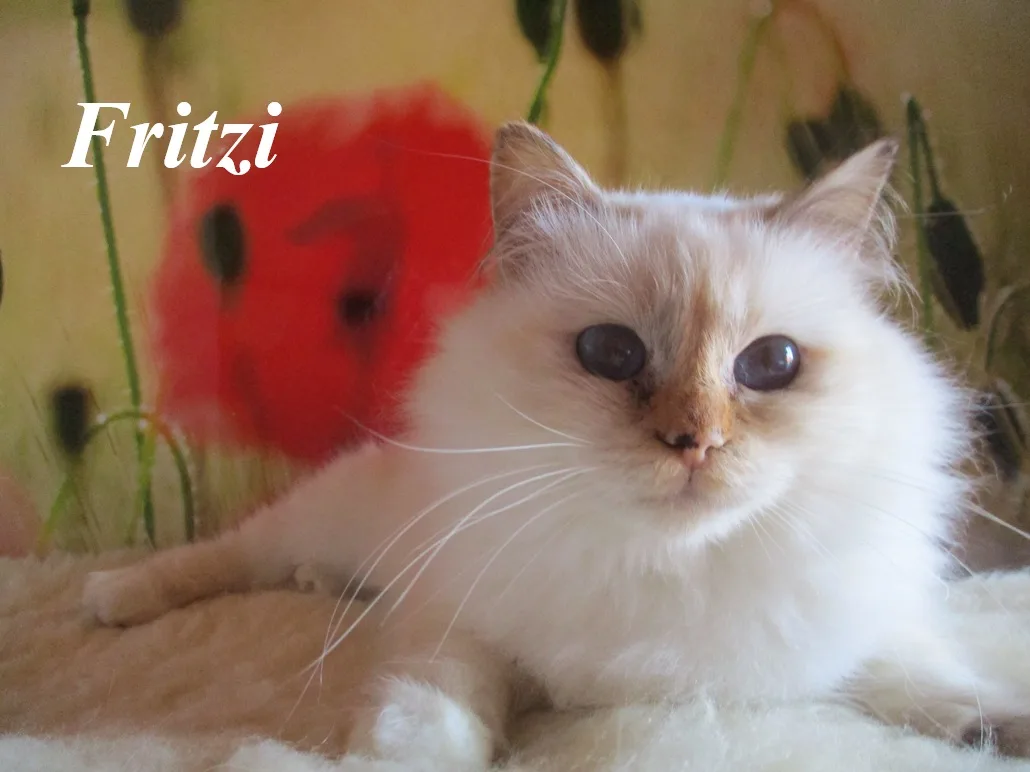
 Fritzi the cosy One
1 result · latest FIP resistance (FIP-R) 03/2025
FIP resistance (FIP-R)
FIPR/FIPR (homozygous) (25.03.2025)
Genimal (France), gene fIFNG, analysis 438186
Genetic trait, not a test for FIP
Here I would like to go into more detail on the topics of preventive care, vaccination and infectious diseases
In principle, it is very important to me that cat owners understand that a cat is not a germ-free creature. You cannot fight every virus, parasite and germ a cat carries with the chemical sledgehammer of medication. It is far more important that a breeder raises healthy, robust kittens that can cope with the burden of viruses and bacteria on their own
How do our little Birmans stay healthy
It is up to us breeders to raise healthy and robust little Birmans
How do I do this
- good, balanced nutrition
- the help of and cooperation with a truly good vet
- fresh air whenever possible, safe outdoor access in the garden
- vaccinate as much as necessary and as little as possible, see my page Vaccination recommendation
- preventive examinations at the right time: HCM scan from 1.5 years and older
- genetic tests for PKD, genetic test for FIP resistance,
- general genetic tests
- as little medication as at all possible: when our cats have something, they are first treated homeopathically.
We strengthen our kittens' defences right from the start, which means that from their 3rd week of life the little ones get Symbiopet in their mouths every day so that a healthy intestinal flora can develop.
We only deworm when a cat moves to a new home; otherwise you can have a pooled stool sample checked for worm eggs at the vet and then deworm.
What I don't do
I often hear that when cats fall ill, people use a sledgehammer (medication) to crack a nut.
We cat owners must understand that cats are not germ-free creatures
We cat owners must understand that viruses are ever-present in our cats, such as coronavirus, herpesvirus, calicivirus etc., and no medication can free our cats of them.
We cat owners must understand that cats with safe outdoor access also get endoparasites and ectoparasites, such as worms or giardia. In my view, we need to support our darlings so that they can cope with them: constant deworming and weeks of medication for giardia weaken the cat more than they help!
What I don't do: with gum inflammation
In my opinion and experience, about 2/3 of all cats have a red gum line. In autumn/winter 2013/2014 I often heard that vets recommend antibiotic therapy or even removal of all teeth.
Come on, think about it: would anyone do that to a human??? Nobody would ever come up with such an idea.
Comprehensive feline blood profile
EDIT 1/2018 Experience over the last few years has shown that cats with unremarkable blood results have died, while cats with poor blood results recovered on their own and are still alive.
This has changed my assessment: I now see the whole thing in a more nuanced way
A comprehensive feline profile costs about € 80, plus only the cost of the blood draw and examination at the vet.
The comprehensive feline profile includes: urea, creatinine, total protein, sodium, chloride, potassium, phosphate, bilirubin, ALT(GPT), AP, AST(GOT), GLDH, glucose, alpha-amylase, lipase, fructosamine, cholesterol, CK, LDH, calcium, magnesium, triglycerides, feline viral diseases (FeLV, FIV, FIP coronavirus titre), serum protein electrophoresis (FIP diagnostics), complete blood count (basic blood count plus differential).
Vaccination recommendation for outdoor cats, breeding and show cats, and cats that have contact with outdoor cats or dogs
Feline panleukopenia: 8 weeks (conditional), 11-12 weeks, 15-16 weeks, 16 months, every 3 years
Cat flu: 8 weeks (conditional), 11-12 weeks, 15-16 weeks, 16 months, yearly
Leukosis: 12 months, 13 months, yearly
Rabies: 11-12 weeks (conditional), 15-16 weeks, every 3 years
*If possible, vaccinate young cats as late as possible, e.g. 1st cat flu/panleukopenia vaccination at 11-12 weeks, 2nd cat flu/panleukopenia vaccination at 15-16 weeks. Vaccinating kittens at 8 weeks is not very effective, as the little ones are still nursing from their mother.
Vaccination recommendation for indoor cats
Feline panleukopenia: 8 weeks (conditional), 11-12 weeks, 15-16 weeks, 16 months, every 3 years
Cat flu: 8 weeks (conditional), 11-12 weeks, 15-16 weeks, 16 months, yearly
Vaccination basics:
vaccinate as little as possible and as much as necessary.
Vaccinate young cats as late as possible, e.g. 1st cat flu/panleukopenia vaccination at 11-12 weeks, 2nd cat flu/panleukopenia vaccination at 15-16 weeks. Vaccinating kittens at 8 weeks is not very effective, as the little ones are still nursing from their mother
Always deworm before vaccinating!
Only vaccinate when the cat is completely healthy and not pregnant!
Don't have all vaccinations given at once!
There is also a very good book on this topic: Katzen impfen mit Verstand by Monika Peichl
http://www.katzenimpfenmitverstand.de/index.shtml
Here I would like to go into more detail on the most important infectious diseases:
FIP Feline infectious peritonitis: in my eyes the worst scourge of cats
It arises from a mutation of the initially harmless FCoV coronavirus; it is estimated that many free-roaming cats and up to 95 % of cats in catteries and shelters carry this harmless virus. In 2 - 10% of cats, the harmless FCoV mutates inside the cat and leads to fatal FIP
no therapy is possible
treatment with infusions, interferon or similar only benefits the vet's wallet and prolongs the suffering of our beloved cats
possible reasons for a mutation
most reports consider a genetic predisposition likely. In my opinion, to put it in layman's terms, it works somewhat like autosomal recessive inheritance! Again in layman's terms, I would say FIP is similar to cancer: it has many different faces, and in humans, too, the predisposition to develop certain types of cancer is inherited, and with human cancer other factors also come into play that ultimately trigger the disease.
An imbalance of the immune system
In my opinion, the stress theory only holds up to a point. Otherwise, why do shows, heat, giving birth and changing living conditions not affect the cats, while their littermates sit on the sofa as a pair in a loving pet home and develop FIP and die?
A high viral load, meaning many cats in one group and constant virus shedders, can lead to more cases of FIP. Unfortunately, it is practically impossible to get a cattery free of coronavirus and keep it that way!!
Young cats up to 2 years of age and very old cats are particularly at risk, because at this stage the immune system is not yet, or no longer, fully developed.
Signs of the disease
Recently, a distinction is no longer made between the dry and the wet form!
Common symptoms are:
- Loss of appetite, apathy and weight loss
- Antibiotic-resistant fever with abdominal pain
- Eye changes, anaemia, jaundice and neurological symptoms (changes in behaviour).
- Nodular changes develop in the internal organs.
- Later, peritoneal or pleural effusion follows; i.e. fluid collects in the abdomen or around the lungs/heart.
FIP has very many faces and can only be confirmed with certainty after death
Diagnosis
At first, the coronavirus titre only tells you that the cat has had contact with the harmless feline coronavirus. Without clinical symptoms and suspicious lab results, it is meaningless!!!
If symptoms of illness appear, you should definitely have a complete blood count with protein electrophoresis done.
According to Professor Dr. Hartmann, puncturing the free fluid in the abdomen is the vet's first step. The fluid obtained is examined using the Rivalta test, which allows FIP to be diagnosed with fairly high certainty.
News on FIP
In recent years there have repeatedly been fatal cases of feline panleukopenia in fully vaccinated catteries, and the Paul-Ehrlich-Institut was called in:
it appears that the conventional vaccination schedule, with the first vaccination at 8 weeks and the second at 12 weeks, does NOT provide sufficient protection
the reason for this is the maternal antibodies that kittens take in with their mother's milk, which render the vaccination at 8 weeks ineffective. That is why I recommend vaccinating at 11 and 15 weeks, or at 8/12/16 weeks
Leukosis (FeLV) is a viral disease that leads to leukaemia-like symptoms as well as tumours and general immune deficiency, meaning cats can contract all kinds of illnesses as a result. About one third of cases are fatal, one third recover completely, and another third recover but remain virus shedders, which are very dangerous for healthy animals. There is an effective vaccine against leukosis that can first be given at 10 weeks. The booster follows at 14 weeks and then yearly.
I recommend the first leukosis vaccination after the change of teeth, i.e. from around 7 months of age.
There are reports linking the leukosis vaccine to tumours at the injection site. According to the veterinary faculty in Munich, this occurs in 1 in 3,000 to 1 in 10,000 vaccinations, so you should keep an eye on the injection site; then this form of tumour is curable.
Everyone has surely heard of rabies. Rabies is always fatal, and because of the danger to humans, rabies in an animal may not be treated. Rabies is a notifiable disease. The first rabies vaccination is given at 12 weeks, followed by a booster at 16 weeks to achieve full protection, which then only needs to be renewed after 3 years!
If your cats always stay indoors, you do not need to vaccinate against rabies; however, for outdoor cats or cats with an outdoor enclosure, the vaccination is mandatory. The rabies vaccination is also required for attending cat shows. Without valid vaccination protection you will be turned away at the entrance. The same applies to vaccinations against feline panleukopenia and cat flu
Fritzi the cosy One1 result · latest FIP resistance (FIP-R) 03/2025